Submissions
Submission Preparation Checklist
All submissions must meet the following requirements.
- The submission has not been previously published, nor is it before another journal for consideration (or an explanation has been provided in Comments to the Editor).
- The submission file is in OpenOffice, Microsoft Word, or RTF document file format.
- Where available, URLs for the references have been provided.
- The text is single-spaced; uses a 12-point font; employs italics, rather than underlining (except with URL addresses); and all illustrations, figures, and tables are placed within the text at the appropriate points, rather than at the end.
- The text adheres to the stylistic and bibliographic requirements outlined in the Author Guidelines.
- The author agrees that, once the process has begun, the journal will not refund the money to the author if they do not comply with the established timeframes for the completion of the peer review process or decide to withdraw the article from the journal once the process has begun. Suppose the author does not submit the corrections within the established timeframe or decides not to comply with the journal's regulations. In that case, the journal reserves the right to reject the article, and payment will not be refunded once the process has begun.
- Once the administrative fee corresponding to the Editorial Cost has been paid and the process has begun, the author undertakes to process the suggestions issued by the first referee within a maximum of 5 months and a maximum of 1 year for the full completion of the process.
- In the context of the increasing use of artificial intelligence (AI) in the generation of academic content, the author agrees to the following policy to ensure integrity, transparency, and rigor in the production and dissemination of scientific knowledge.
- RTED is published semiannually and implements a scheme based on the editorial cost to cover the operating expenses associated with the publication Consult Editorial Cost which is the charge, cost or amount for processing that some journals require from authors for the publication of their articles in open access. This Editorial Cost is applied to all academic, administrative, teaching, student, and research collaborators. The amount varies according to the number of authors, see the link, and the maximum is seven (7) authors. Consult Editorial Cost
Copyright Notice
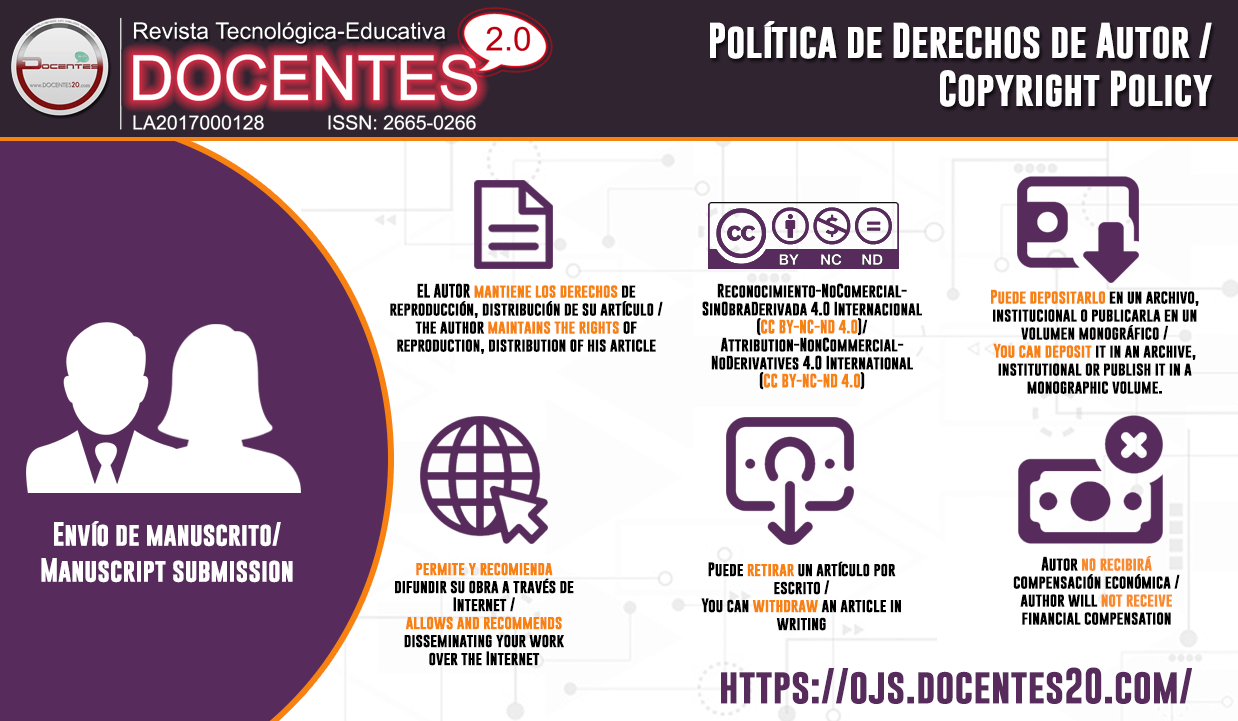
Copyright and License
- Authors retain full copyright ownership of the works published in Revista Docentes 2.0. The journal does not require exclusive transfer of copyright.
- The journal obtains a non-exclusive license for the first publication of the manuscript and its dissemination in the corresponding editorial formats.
- The published version is distributed under the Creative Commons Attribution-NonCommercial-NoDerivatives 4.0 International (CC BY-NC-ND 4.0) license.
- This license governs third-party use and permits copying and redistribution of the material in any medium or format, provided that proper credit is given to the authors and the journal, the material is not used for commercial purposes, and no modifications, adaptations, or derivative works are made. Any use not expressly permitted by the license requires authorization from the copyright holder.
- The journal does not impose additional restrictions beyond those established in the applicable Creative Commons license.
- Authors retain their moral and economic rights and may reuse their work in future publications, including books or academic compilations, provided that the original publication is properly cited.
Self-Archiving
- Deposit of the accepted version and the published version of the article in institutional repositories and personal websites is permitted without embargo, provided that the full reference to the original publication and the corresponding DOI are included.
- The journal does not accept manuscripts that have been previously published on preprint servers.
Withdrawal, Corrections, and Retractions
- Withdrawal requests submitted prior to publication must be made in writing to the Editor or the Editorial Committee. Withdrawal becomes effective only after the journal provides formal confirmation.
- After publication, any correction, retraction, or expression of concern will be managed in accordance with the guidelines of the Committee on Publication Ethics (COPE). Retractions, when applicable, will be published transparently in the online version of the article.
Financial Compensation
- Publication in Revista Docentes 2.0 does not generate financial compensation for authors.